Introduction

Introduction:
Torrins brings you an exciting lesson on The Thrill Is Gone, the legendary blues song made famous by B.B. King. Taught by Mike Dugan, this lesson is perfect for those looking to master both rhythm and lead guitar in a blues setting. You'll learn everything from chords and rhythm to soulful lead fills and solo techniques.
Fun Fact: While most people associate "The Thrill Is Gone" with B.B. King, the song was originally written and recorded by Roy Hawkins and Rick Darnell. However, B.B. King’s version became a massive hit, earning him a Grammy Award for Best Male R&B Vocal Performance in 1970 and a spot in the Grammy Hall of Fame in 1998.
Chords & Rhythm
This lesson starts by breaking down the essential chords used in the song. The song is in the key of B minor, incorporating barre chords like Em, F#7, and others in a 12-bar blues progression. Mike explains the finger placements for each chord, ensuring clarity for both beginners and advanced players.
The rhythm follows a straightforward 4-feel, meaning it doesn’t use shuffle or swing. Mike provides an easy method to simplify the rhythm, explaining the accents and muting techniques that bring the groove to life.
Sing and Play Technique
One of the key elements of this song is matching vocals with guitar playing. The song follows a typical blues structure where the first line is repeated, making it essential to synchronize your playing with the melody. Mike shares helpful tips on keeping time and smoothly integrating vocals with guitar.
Solo & Lead Fills
Next, we dive into the iconic solo heard in the introduction. The solo is based on the B minor pentatonic scale, and Mike walks through each lick, ensuring you understand the phrasing and feel that make B.B. King’s style so expressive.
Following the solo lesson, the instructor covers lead fills, which are played in between vocal phrases. He sticks to the B minor pentatonic scale, showing how to create emotional lead parts.
Song Demo & Final Arrangement
The lesson concludes with a full song demo, allowing you to hear all the elements come together. The final arrangement follows the classic 12-bar blues progression, with a structure of intro, two verses, solo, two verses, and outro. Mike plays along with the backing track, reinforcing everything covered in the lesson.
Why Learn "The Thrill Is Gone"?
- Great way to practice 12-bar blues progressions.
- Helps improve lead guitar phrasing and soloing.
- Perfect for learning how to sing and play simultaneously.
FAQs -The Thrill Is Gone Guitar Lesson
Q1. Is this song beginner-friendly?
Yes! While some barre chords are involved, Mike provides tips to make them easier.
Q2. Do I need a capo for this lesson?
No capo is required!
Q3. What’s the best way to practice lead fills?
Start slow and break the fills into smaller sections. Play along with the backing track to develop feel and timing.
The Thrill is Gone
Introduction
Chords and Rhythm
Sing and Play
Solo Lesson
Lead Fills
Song Demo
Introduction:
Torrins brings you an exciting lesson on The Thrill Is Gone, the legendary blues song made famous by B.B. King. Taught by Mike Dugan, this lesson is perfect for those looking to master both rhythm and lead guitar in a blues setting. You'll learn everything from chords and rhythm to soulful lead fills and solo techniques.
Fun Fact: While most people associate "The Thrill Is Gone" with B.B. King, the song was originally written and recorded by Roy Hawkins and Rick Darnell. However, B.B. King’s version became a massive hit, earning him a Grammy Award for Best Male R&B Vocal Performance in 1970 and a spot in the Grammy Hall of Fame in 1998.
Chords & Rhythm
This lesson starts by breaking down the essential chords used in the song. The song is in the key of B minor, incorporating barre chords like Em, F#7, and others in a 12-bar blues progression. Mike explains the finger placements for each chord, ensuring clarity for both beginners and advanced players.
The rhythm follows a straightforward 4-feel, meaning it doesn’t use shuffle or swing. Mike provides an easy method to simplify the rhythm, explaining the accents and muting techniques that bring the groove to life.
Sing and Play Technique
One of the key elements of this song is matching vocals with guitar playing. The song follows a typical blues structure where the first line is repeated, making it essential to synchronize your playing with the melody. Mike shares helpful tips on keeping time and smoothly integrating vocals with guitar.
Solo & Lead Fills
Next, we dive into the iconic solo heard in the introduction. The solo is based on the B minor pentatonic scale, and Mike walks through each lick, ensuring you understand the phrasing and feel that make B.B. King’s style so expressive.
Following the solo lesson, the instructor covers lead fills, which are played in between vocal phrases. He sticks to the B minor pentatonic scale, showing how to create emotional lead parts.
Song Demo & Final Arrangement
The lesson concludes with a full song demo, allowing you to hear all the elements come together. The final arrangement follows the classic 12-bar blues progression, with a structure of intro, two verses, solo, two verses, and outro. Mike plays along with the backing track, reinforcing everything covered in the lesson.
Why Learn "The Thrill Is Gone"?
- Great way to practice 12-bar blues progressions.
- Helps improve lead guitar phrasing and soloing.
- Perfect for learning how to sing and play simultaneously.
FAQs -The Thrill Is Gone Guitar Lesson
Q1. Is this song beginner-friendly?
Yes! While some barre chords are involved, Mike provides tips to make them easier.
Q2. Do I need a capo for this lesson?
No capo is required!
Q3. What’s the best way to practice lead fills?
Start slow and break the fills into smaller sections. Play along with the backing track to develop feel and timing.
The Thrill is Gone
Introduction
Chords and Rhythm
Sing and Play
Solo Lesson
Lead Fills
Song Demo
Explore More in English Songs





Introduction
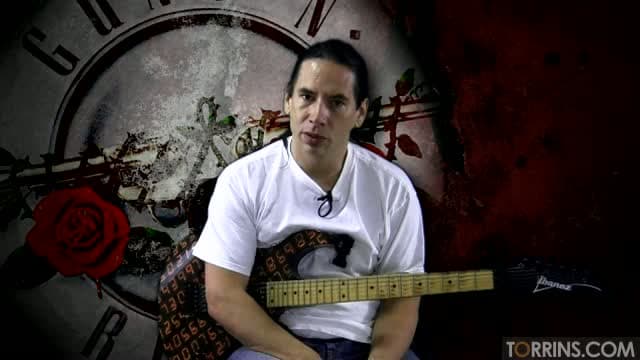
Tune into Torrins’ guitar song lesson on the iconic single by American rock band Guns N' Roses, Sweet Child O’ Mine. This chart-topping hard rock song is taught by our instructor, Mike Walker. He has broken down the lesson into 10 parts for a detailed understanding of each section and to make learning easier. Find dedicated lessons on the intro, verses, choruses, interlude solos, main solo, and outro.
Fun Fact: "Sweet Child O' Mine" was born out of a playful jam session at the band’s house. Slash was fooling around with a "circus" melody to make drummer Steven Adler laugh when Izzy Stradlin suggested turning it into a song. Within an hour, the band had crafted the core structure, and Axl Rose, inspired by his girlfriend Erin Everly, wrote the heartfelt lyrics by the following afternoon.
Chords Used in Sweet Child O' Mine Guitar Lesson
This song is played in half-step down tuning and features a mix of open chords and power chords. Some of the key chords used in the song include:
- C, D, Cadd9
- A power chord, Dsus4
Tune into the full lesson to learn all the chords and how to transition between them seamlessly.
Strumming Pattern
- Intermediate/advanced rhythm: Alternating strumming pattern with pull-off techniques for added depth
- A lick is layered over the chorus, and Mike walks you through how to blend it into the song smoothly
Song Structure
This song follows a well-defined verse-chorus format:
- Intro Riff – The iconic opening lick is based on a repetitive motion with just the first note changing. It’s repeated twice.
- Verse 1 & 2 – Follows an 8-bar phrase played twice using three chords. Incorporates a pull-off pattern. Mike breaks down the intricacies of the verses in great detail.
- Chorus – Mix of power chords and open chords like A power chord, C5, and Dsus4. A lick is played over the chorus for added texture.
- Solo 1 – The rhythm underneath the solo is half the length of the verse.
- Verse 2 – Similar to Verse 1.
- Chorus 2 – Same as Chorus 1.
- Solo 2 – A longer solo covering an entire verse.
- Chorus 3 – Double the length of the previous choruses.
- Outro Solo – Includes wah-wah pedal, hammer-ons, pull-offs, sliding, and some resting measures for dynamic effect.
Why Learn Sweet Child O' Mine?
This lesson covers not just the guitar parts but also the feel and dynamics that make the song iconic.
- Learn the nuances of Slash’s soloing style
- Improve your pull-offs and hammer-ons
- Master playing with a wah-wah pedal for expressive control
FAQs – Sweet Child O' Mine Guitar Lesson
Q1. Is this song beginner-friendly?
Ans: This lesson is ideal for intermediate and advanced players.
Q2. What’s the trick to mastering the intro riff?
Ans: Focus on the repetitive pattern and ensure the other strings are muted for a clean sound.
Introduction:
Torrins brings you an exciting guitar lesson on Sultans of Swing by Dire Straits, taught by Mike Dugan. This song blends fingerstyle finesse with classic rock grooves, and Mike breaks it all down into bite-sized lessons so you can follow along at your own pace.
Interesting Fact
Mark Knopfler originally wrote the song on a National Steel guitar in open tuning. He thought it sounded dull—until he tried it on his 1961 Fender Stratocaster. The moment he plugged it in, the song “came alive,” and the now-famous chord changes practically wrote themselves.
Chords & Progression
This song is in the key of D minor and uses both barre and open chords.
Chords include: Dm (barre), Bb, A7, F, and others.
The progression is smartly structured across the different sections, and Mike breaks down which chords go where and how they’re distributed across measures.
Song Structure
Each section is covered in detail, including how the chords and rhythms evolve throughout the song.
Intro Rhythm and Bounce Feel
One of the most iconic parts of Sultans of Swing is its bounce. Mike explains how this bounce is created by returning to the D minor chord in the intro, and how to use finger lifts and muting to shape the rhythm. He simplifies the feel for beginners while encouraging a relaxed hand to avoid letting the guitar ring too much. The subtle muting helps create those signature accents that make this riff so catchy.
Riff Rhythm
The riff acts as the instrumental bridge between verses and chorus, and it’s rhythmically complex. Mike shares a unique method to help you internalize the up and down strumming pattern and nail the timing.
Verse and Chorus – Singing & Playing Together
Mike walks you through how to match your vocals with the guitar parts, offering tips on timing and phrasing. The chorus uses a repetitive chord progression, so once you lock it in, you can focus more on dynamics and vocal delivery.
Intro Lead and Riffs
The lead parts are based around the D minor pentatonic scale, with one note borrowed from F major, and also include arpeggios. Mike breaks this down note by note, making the intro riff approachable even for those who are new to lead playing.
Solo Improvisation
The end solo of the song is a masterclass in feel and phrasing. Mike starts at the 10th fret and teaches the solo string by string. He introduces a cool technique called calming, along with triplet patterns, giving your solo a more expressive touch.
Main Riff Breakdown
To wrap up, Mike teaches the main riff of the song, played using a pick and two fingers for a hybrid picking effect. The riff includes the D minor triad and showcases how intricate fingerpicking can add character to a song.
FAQs – Sultans of Swing Guitar Lesson
Q1: Is this song beginner-friendly?
It’s more suited for intermediate players, but Mike breaks it down clearly, and beginners can still follow along section by section.
Q2: Do I need a capo?
No capo is needed for this version.
Q3: How do I get the “Knopfler feel”?
Focus on muting, dynamic accents, and hybrid picking. Let the rhythm breathe, and play with feel over flash.



Introduction:
Torrins brings you an electrifying guitar lesson—Symphony of Destruction by Megadeth, taught by Clay Foster. This heavy-hitting metal track is part of our guitar song lesson series and is broken down into easy-to-follow sections.
Fun Fact: In an interview, vocalist Dave Mustaine shared that the lyrics for Symphony of Destruction were sparked by a headache he got while driving home. He scribbled the first lines on the back of a sushi receipt—“My metal brain’s corroding, my head is going to explode.” That spontaneous moment led to one of Megadeth’s most iconic songs, recorded on their fifth studio album Countdown to Extinction in 1992.
Song Arrangement
The song is taught in separate segments so you can master each part before moving to the next.
The song is in the key of E.
Verse
Verse is built around the F power chord and an open E power chord, along with other chords.
Downstrokes and palm muting are used in the verse—make sure to mute the strings to avoid letting notes ring out too long. Clay shares techniques like using your thumb or extra fingers to stop the sound cleanly.
Pre-Chorus
Features open palm muting and chromatic downs, creating that tight, chugging rhythm. Our lessons have a 3-angle video setup so you can clearly see hand positions and copy along easily.
Chorus
This section opens up with ringing E chords and a chromatic descending run. Chords like Bb, G#, and the D power chord makes the chorus sound more intense. Though it’s slightly more complex than the verse, Clay carefully breaks down the finger positioning and covers some fingerpicking techniques to help you through it.
After the first chorus, the main riff returns and leads into the second verse and pre-chorus, just like earlier.
The second chorus is a bit longer. The first half mirrors the first chorus, while the second half introduces new elements. Clay walks you through the difference so you can follow along confidently.
Solo Lesson
Clay breaks down the guitar solo into manageable sections.
- The first part has a bluesy riff with vibrato, bending, and palm muting.
- The second part is a 16-note rhythmic figure built around the Am6 chord, featuring some sliding techniques.
- Tune into the lesson to learn each section in detail and pick up essential phrasing skills along the way.
Sound and Tone
To capture the song’s feel, Clay dives into the tone settings. The tone is mid-rangy, which is a signature sound of Marty Friedman. Clay recommends listening to some of Friedman’s work to understand the sweet, expressive tone he’s known for.
For gear settings, Clay suggests using the middle pickup to replicate that tone more accurately.
Song Demo
The lesson wraps up with a full song demo, where Clay ties everything together. You can play along with him to practice transitions, polish your technique, and check your accuracy in real time.
FAQs – Symphony of Destruction Guitar Lesson
Q1: Is this song beginner-friendly?
Yes. While it has a few technical sections, the lesson breaks everything down clearly and provides enough guidance for newer players.
Q2: Do I need specific gear for the tone?
Clay suggests using a mid-range-focused setting with the middle pickup to get closer to Marty Friedman's tone. However, you can start with what you have and tweak as needed.
Q3: Is the solo hard to learn?
It’s approachable when broken into parts. Clay walks you through each phrase, so with some practice, you’ll be able to nail it.

Similar Blues Songs


Introduction:
Torrins brings you another legendary blues guitar lesson—Stormy Monday as played by The Allman Brothers Band, taught by Mike Dugan. This classic blues song is packed with soulful chords, smooth rhythm, and expressive lead playing, making it a must-learn for any blues guitarist.
Fun Fact: Originally written by T-Bone Walker, Stormy Monday inspired blues legends like B.B. King to pick up the electric guitar. Moreover, the Allman Brothers' 1971 version, with jazzy organ and extended solos, transformed it into an iconic 8-minute masterpiece.
Chords & Song Arrangement
- This song follows a 12-bar blues progression in the key of G, incorporating both open and barre chords:
- Chords Used – G#7, Am7, Bbm7, and more. Some chords are barre chords, but Mike provides easier alternatives for different playing levels.
- Since T-Bone was known for his 9th chords, Mike also teaches 9th chord variations to bring out that authentic blues feel.
- The song includes a subtle sharp climb, adding to the T-Bone Walker-style phrasing.
Rhythm & Strumming Pattern
- Time Signature: 4/4
- Main Rhythm: A slow blues groove with a simple strumming pattern at first.
- Alternative Rhythm: A 6-feel rhythm (double-time feel), adding an upbeat bluesy bounce.
Mike also demonstrates advanced rhythmic techniques, incorporating double stops, slides, and dynamic accents to enhance the song’s groove.
Intro Lick, Turnaround & Ending
- Intro Lick – A G9 chord-based intro, first broken down in a simplified version before introducing more advanced variations using sharp and augmented chords.
- Turnaround – Mike walks through classic turnaround chords, showing how they fit into the blues form.
- Ending – He teaches a common blues-style ending which is useful for countless other blues songs.
Sing & Play – Coordinating Vocals & Guitar
Want to sing while playing? Mike shares practical tips on how to sync your vocals with the guitar. He encourages adding your own feel to the song while staying true to its blues roots.
Lead Fills & Lead Playing
- Lead Fills: The lesson starts with small lead fills that complement the vocals.
- Key & Scales: He uses the G minor pentatonic blues scale and major blues in G for expressive phrasing.
- Playing Lead in Slow Blues: Mike demonstrates bends, sustains, and dynamics, making your solos sound rich and emotional.
Improvisation & Playing with a Backing Track
- Here Mike explains how to improvise and when to use the major vs. minor scale. He also demonstrates how to craft a melodic, bluesy solo.
- Follow his approach, and soon, you’ll be confidently improvising your own slow blues solos!
Final Playthrough with Backing Track
To wrap up the lesson, Mike plays the full song with a backing track, reinforcing all the techniques covered. Watch closely and play along to lock in the feel and phrasing of this blues classic.
Why Learn Stormy Monday?
- Classic blues structure – great for understanding blues chord progressions.
- Improves both rhythm & lead playing – covers everything from chords to expressive solos.
- Perfect for improvisation – teaches you how to craft slow blues solos with feel.
FAQs – Stormy Monday Guitar Lesson
Q1: Is this lesson beginner-friendly?
Yes! Mike provides simplified chord alternatives and breaks down the song step by step.
Q2: What’s the most challenging part?
The double-time solo can be tricky, but Mike teaches how to ease into it.
Q3: How do I make my solos sound bluesier?
Focus on bends, vibrato, and using both the major & minor blues scales—all of which Mike explains in detail!


Introduction:
Learn to play Elmore James' version of "It Hurts Me Too" with this detailed guitar lesson on Torrins.com taught by our instructor Mike Dugan. This classic 8-bar blues song features soulful melodies, a walking bassline, and the Delta blues technique, making it a must-learn for blues enthusiasts. This lesson includes chords, rhythm techniques, solo breakdowns, and a full song demo, with tabs and lyrics provided for a complete learning experience.
Fun Fact:
"It Hurts Me Too" is one of the most interpreted blues songs ever! Originally recorded by Tampa Red in 1940, Elmore James' recorded it once in 1957 and then in 1962. His 1962 version became a hit, staying on the Hot Rhythm & Blues Singles chart for eight weeks and even making its way to Billboard’s Bubbling Under Hot 100 Singles chart two years after his passing.
Chords & Rhythm in "It Hurts Me Too"
- Key: D
- Chords Used: D7, A7, and others. Tune into the lesson to learn the rest of the chords used.
- Rhythm Pattern: DUDDUDDUDDUD (He also teaches an alternative positioning for a different feel.
- For advanced players, a Chuck Berry-style rhythm is introduced to add a more dynamic groove.
- The Delta blues technique is broken down in detail, ensuring you capture the authentic blues sound.
Sing & Play Section
- The lesson covers how to match vocals with chord changes and maintain steady downbeat strumming.
- The punchline of each verse remains the same, making it easier to follow along while singing.
Solo Breakdown
- The solo begins in the D major blues scale, bringing a bright and melodic sound.
- After a few measures, it shifts into D minor pentatonic, adding emotional depth and contrast.
- Mike Dugan explains this major-to-minor blues transition, a technique that gives the song its signature feel.
Song Demo
- In this final section, Mike plays the full song with a backing track, bringing together all elements learned in the lesson. Follow along with him to learn the intricacies of this song perfectly.
Why Learn "It Hurts Me Too"?
This lesson is a great way to improve blues phrasing, rhythm control, and soloing techniques. Whether you're a beginner looking to learn essential blues progressions or an advanced player eager to refine your Delta blues technique, this song is an excellent addition to your repertoire.
FAQs – "It Hurts Me Too" Guitar Lesson
Q1. Is this lesson beginner-friendly?
Yes! The song uses simple chords, and the lesson breaks everything down step by step, making it accessible for all skill levels.
Q2. Can I play the song without singing?
Absolutely! The lesson teaches the instrumental parts separately, so you can focus on mastering the guitar before adding vocals.
Q3. How do I improve my blues soloing?
This lesson introduces a major-to-minor blues shift, a great technique for creating emotional and expressive solos. Practice this transition to add more depth to your playing. Moreover, you can also check out our in-depth Blues Guitar lessons to improve your skills.



Songs with Similar Difficulty


Introduction
Get ready to master another hit song on Torrins—If It's Love by Train. This moderate-level lesson is taught by Steve Luciano, who breaks down the song into easy-to-follow sections. You'll learn about the chords, strumming patterns, and intricate techniques that make this song so engaging. Steve also shares detailed tips on finger placements and rhythm to help you recreate the authentic feel of the original track.
Fun Fact: If It's Love was written on the same day as Train's hit Hey, Soul Sister in New York City. Pat Monahan wrote it as a love song for the band's long-time fans, thanking them for their unwavering support over the years.
Chords Used in If It's Love
The song is tuned half a step down and features a mix of standard and suspended chords. Some of the key chords used include:
- G triad
- G chord
- Gsus4
- Csus4
- D4
- Dsus/F#
- G/B
Tune in to the lesson to learn the other chords that make up this song. Steve carefully explains the finger placements for these chords, especially complex chords like Dsus/F#, to ensure you get the right tone.
Strumming Pattern
The song starts with a drum section, and Steve demonstrates how to simulate that drum feel using strumming techniques.
- In the beginning, the rhythm follows a 16th note pattern: DUDUDUD
- As the song progresses, the pattern shifts to: DDUUUD
Steve emphasises the importance of keeping your right hand moving to maintain a consistent rhythm. He also explains how to incorporate sliding and arpeggios into your strumming to enhance the song's texture.
Song Structure
If It's Love follows a clear and structured format. Tune in to the lesson to understand the arrangement of the song.
In the beginning, Steve uses just 3–4 chords, making it approachable for most players.
As the song progresses, he introduces more complex chords like Dsus/F#, adding depth to the arrangement
Steve concludes the lesson by playing along with the song, demonstrating smooth transitions between sections.
Improvisation Techniques
For more advanced players, Steve teaches how to improvise over the progression using slides and arpeggios. He also explains how to replicate the original feel of the song by experimenting with the rhythm and strumming intensity.
Why Learn If It's Love?
This song is an excellent way to improve your chord transitions and rhythm skills. It also introduces suspended chords and alternate fingerings, helping you build greater versatility in your playing.
Tips to Control Strumming Intensity:
- Keep the beginning section light with gentle strumming.
- Add more intensity in the chorus by strumming harder and using accents.
- Maintain a steady rhythm throughout the song to keep the groove intact.
FAQs – If It's Love Guitar Lesson
Q1. How can I improve my rhythm and timing?
Practice with the backing track and focus on Steve’s tips for simulating the drum section with your strumming.
Q2. Do I need to tune down my guitar?
Yes, the song is tuned half a step down for an authentic sound.
Q3. How can I handle the suspended chords more smoothly?
Steve suggests specific finger placements and transitions to make switching between suspended chords easier.